
Finding People in the Arvada Residents Directory
People in Arvada appear in separate records because each custodian records a different event. The Jefferson County assessor describes a parcel and its owner. The recorder indexes deeds, liens, plats, and other instruments. The Colorado voter lookup tests one person against a name, ZIP, and birthday. A court docket shows a party and a hearing index, while a newspaper or directory supplies a dated historical clue. Begin with the record that matches the question rather than treating one name hit as proof of a current household.
The most useful trail moves from broad identity to narrow confirmation. A city-labeled address may fall on the Adams County side of Arvada, and a tax mailing address may differ from the property address. Historical listings may name a telephone subscriber, not an owner. A good search keeps those distinctions in view.
- Check the city and county status with the Jefferson County Address Lookup and the city property-map route.
- Search the Jefferson County Property Records Search by owner or address and save the PIN, AIN, situs, mailing, and legal-description fields.
- Use Go Vote Colorado Find My Registration for one known person, using the previous ZIP if a recent move may explain a failed match.
- Check the Colorado court docket and the recorder index, then ask the clerk or recorder for the full file or a certified copy when the index is not enough.
- For older names, move to library newspapers, telephone directories, the Historical Society, or the State Archives, and use a focused CORA or CCJRA request for records not indexed online.
Where Arvada Resident Records Live
The records trail begins with the office that owns the record, not with a generic name search. Arvada’s City Clerk routes city-held material through the Records and Requests page, including MuniDocs, police and code records, municipal court, permits, and other CORA requests. Jefferson County handles the principal parcel, deed, tax, GIS, court, and election systems for the Jefferson side of the city.
Jefferson Clerk and Recorder
100 Jefferson County Parkway, Suite 2560
Golden, CO 80419
303-271-8121
Jefferson County Assessor
100 Jefferson County Parkway, Suite 2500
Golden, CO 80419
303-271-8600
Jefferson County Elections
3500 Illinois Street, Suite 1100
Golden, CO 80401
303-271-8111
The City Clerk’s posted hours are 8 a.m. to 5 p.m., Monday through Friday. The county offices use different hours and locations, so confirm the route before a counter visit. An office card identifies a custodian and access path; it does not mean that the office maintains a complete resident roll.
The city’s public-record page is shown in the official Arvada records-office capture. It separates city archive material from permits, municipal court, police, code, and general requests, which helps keep a search focused.
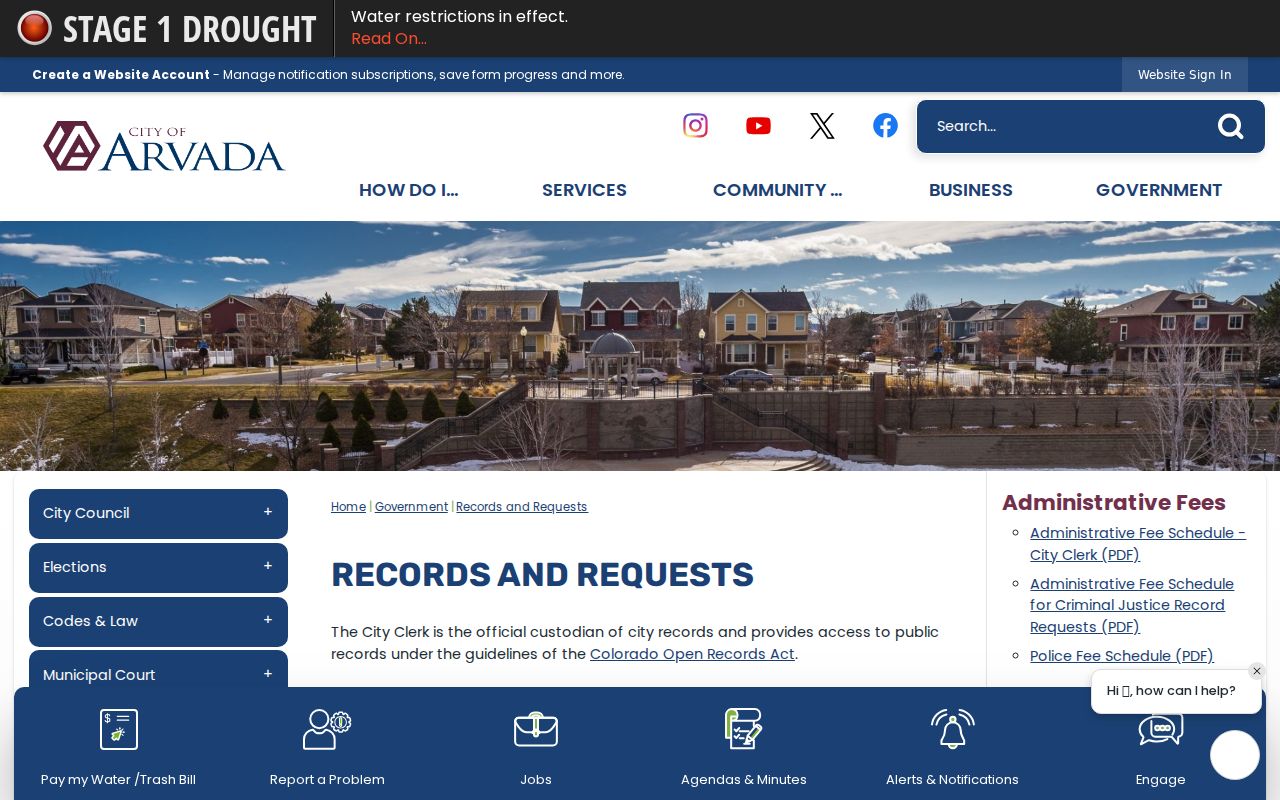
The page is an orientation aid. A precise request still needs a department, record type, address or name, date range, and preferred delivery route.
Arvada County Check for Residents
Arvada spans Jefferson and Adams counties. That geographic fact changes the first search step. A postal city label does not prove that Jefferson County owns the parcel record, and a city address is not automatically inside the incorporated boundary. Jefferson’s Address Lookup asks for a house number and street selection, then reports municipal status and links to map, parcel, and tax information. The city’s maps and property page provide a second boundary check.
For a Jefferson-side address, the assessor, treasurer, jMap, recorder, and Jefferson court are the main chain. For an Adams-side address, switch county systems before interpreting an empty result. This is more than a technical detail. A failed county search can mean the record is held elsewhere, not that the person or parcel is absent.
Search Arvada Parcel Records
The Jefferson assessor is strongest when the search starts with a parcel question. Its address form accepts the parts that often get lost in a casual lookup. Search a street name with the listed street type, test the direction offered by the dropdown, add a unit when needed, and select the city and ZIP. The result grid can return property address, city, postal code, PIN, AIN, TAG, owner, property class, and mailing address.
| Assessor field | Type | Arvada search note |
|---|---|---|
| Address Number | Text | Use the house number when known. |
| Pre-directional | Dropdown | Options include E, N, NW, S, SE, SW, and W. |
| Street Name | Text | Use the portal’s spelling and avoid early shortening. |
| Street Type | Dropdown | Types include AVE, BLVD, CIR, CT, DR, LN, RD, ST, TER, TRL, WAY, and others. |
| Unit Number | Text | Test a unit when a parcel has multiple addresses. |
| City and Postal Code | Dropdowns | Use ARVADA and the ZIP returned by the address evidence. |
The City Hall parcel inspected by the assessor shows why the output needs careful reading: its situs ZIP is 80004 while the displayed Arvada mailing ZIP is 80002. A mailing address can be another property, a post-office box, an agent, or a care-of line. It is a correspondence clue, not proof that an owner lives at the parcel.
The assessor also says it does not perform chain-of-title research, determine boundary lines, or research easements and liens. Use the recorded deed, plat, legal description, or a surveyor for those questions. A parcel card is one step in the Arvada residents directory, not the whole answer.
Arvada Voter Match Records
Colorado’s public lookup is an individual match, not a ZIP-wide or street-wide resident list. The Find My Registration form asks for first name, last name, ZIP, and full birthday. If a person recently moved, the state page suggests trying the prior ZIP. A confidential record or an under-18 record may not appear, and the county clerk is the right place to ask about a failed match.
The public voter-file rules distinguish fields that may be furnished from fields that stay confidential. Full name, residence address, party affiliation and date, phone if supplied, gender identity if supplied, birth year, and prior-election participation are identified as public fields. Social Security number, driver-license number, month and day of birth, signature, and email remain confidential. A result says something about registration. It does not reveal ballot choices or prove that a person occupies a parcel.
The official Colorado voter lookup capture shows the four-field match form and its non-match cautions.
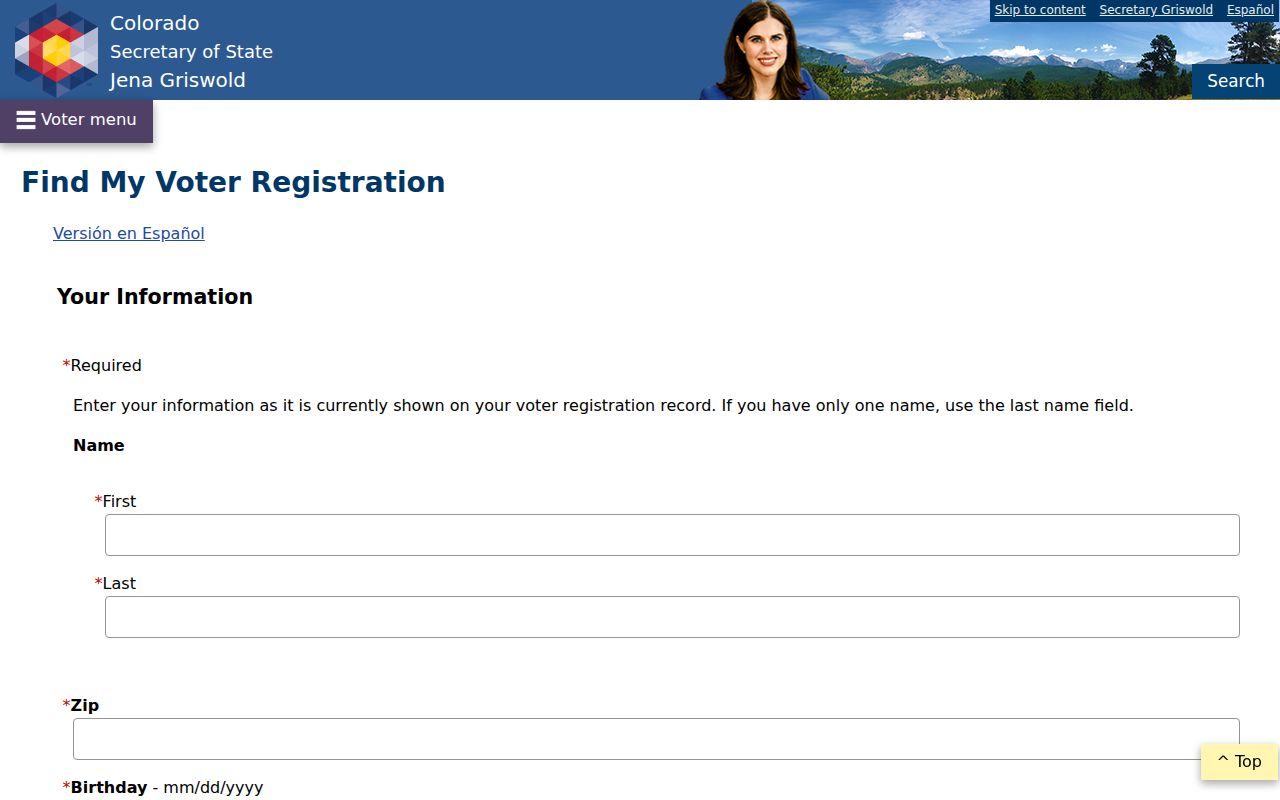
Use the result as one independent attribute, then compare it with a parcel, deed, court, or historical record without copying confidential fields.
Arvada Deed Records: 1970 Layer
Jefferson County’s recorder has two dates that must not be blended. The county describes scanned real-estate records from 1859 forward. A February 2025 expansion added 600,000 records and made real-estate and related records searchable back to 1970. A scanned image can exist without a modern name index, a convenient web result, or a complete online chain.
For a current owner, save the assessor’s sale-history document number, then search the Aumentum Land Records system or the legacy grantor-grantee form. Search as grantor, grantee, or both. Try pure-alpha before exact match, vary punctuation, add a date range, and use the instrument type when the name is common. Read the legal description, reception number, date, and party role before stepping to the prior transfer.
The recorder’s index and public images are not the same as a certified copy. Jefferson’s copy form supports regular or certified paper copies, and the recorder counter or archive book is the fallback when the web search stops. A name in a deed can show a recorded party. It does not by itself show a current resident.
Arvada Court Dockets and Full Files
A court name hit has to be placed in the right court. Arvada Municipal Court handles municipal traffic, parking, code citations, and related city matters. Other incidents inside the city may belong to Jefferson County Court, the First Judicial District, or the federal District of Colorado. The Colorado Judicial Branch Dockets portal requires a search filter in addition to a date and supports location, case number, party, attorney, and date fields.
| Docket result field | What it can show |
|---|---|
| Party and case number | The indexed party display and case identifier, subject to same-name risk. |
| Date, time, and duration | The scheduled hearing event shown in the result set. |
| Hearing type and location | The event category and courthouse or courtroom information. |
| Appearance type | The appearance label supplied by the docket result. |
| Export and printable controls | Ways to retain the index view, not a substitute for the case file. |
The official Colorado court docket capture shows the location, party, attorney, date, and case-number search groups.
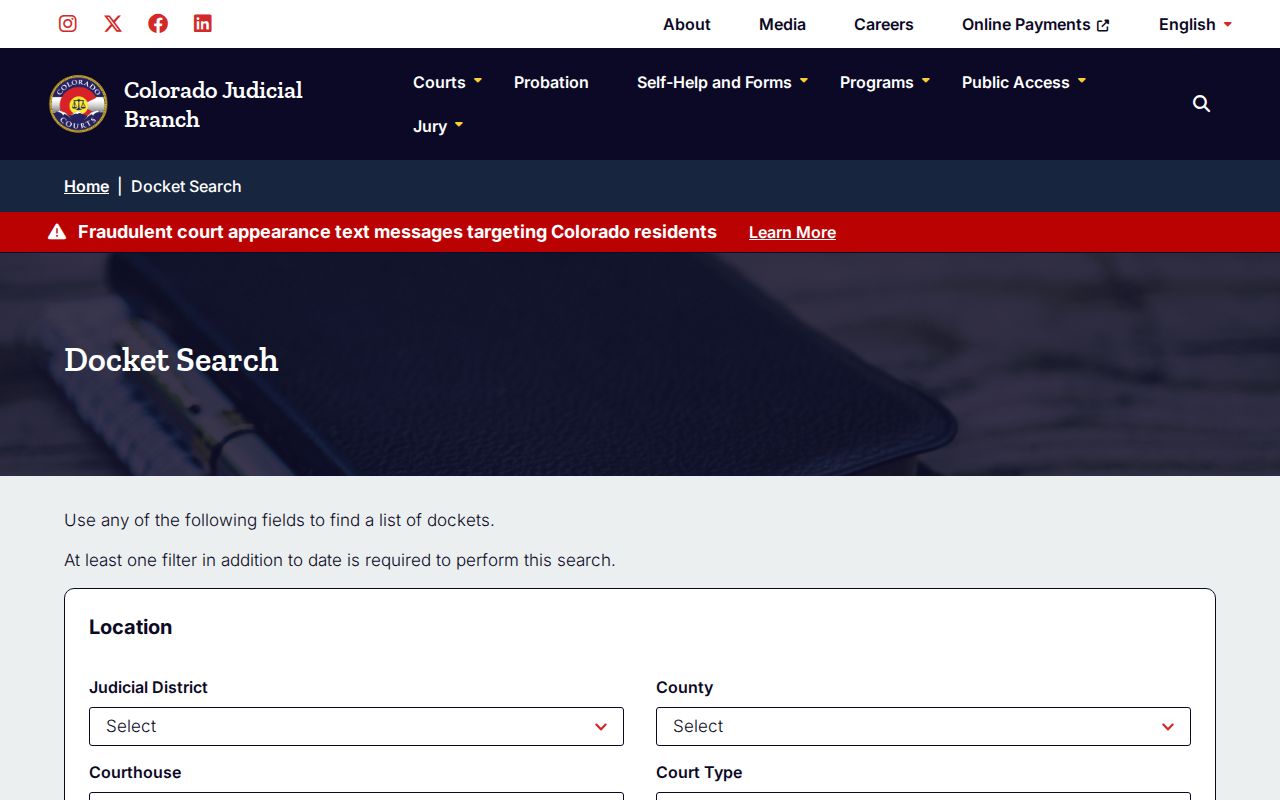
The Jefferson Combined Court counter in Golden, its research line, and the official court-record request form are the next steps for a register of action, copy, certified document, or older file. The request form lists copy, name-search, certification, transcript, and research fees, while juvenile, sealed, suppressed, and confidential material follows separate rules. Arvada Municipal Court states a four-year retention period and a $5 basic record check, with additional research charges possible.
Today's Arvada Resident Directory Sources
No current directory covers every Arvada household. The useful sources are narrower rolls with clear custodians and limits. The table below keeps owner, registration, recorded-party, civic-document, and neighborhood information distinct.
| Source | Who may appear | Keeper | Access |
|---|---|---|---|
| Property parcel card | Recorded owner and tax mailing fields | Jefferson Assessor | Free current portal |
| Voter match | One registered voter who matches the form | Colorado SOS and county Elections | Free individual lookup |
| Recorder index | Grantors, grantees, lien and plat parties | Jefferson Clerk and Recorder | Free index; copies separate |
| MuniDocs | Officials, applicants, speakers, signers, and civic participants | City of Arvada | Free archive; collection dates vary |
| Neighborhood Leader Network | Named associations and civic contacts | City of Arvada | Free directory; no member roster located |
MuniDocs contains more than 30,000 searchable city documents, but it is a civic-office and public-event trail rather than a household roll. The city’s eTRAKiT permit system can add an address, applicant, contractor, inspection, or project chronology. Those contacts help place an event in time; they do not establish occupancy.
Colorado’s business and license tools add a different kind of identity evidence. The Secretary of State Business Entity Search supplies filing identity and history, while DORA’s license search supplies current status. Both are affiliations or credentials, not a household locator.
The business search capture shows the state form and filing-history route used for an Arvada record trail.
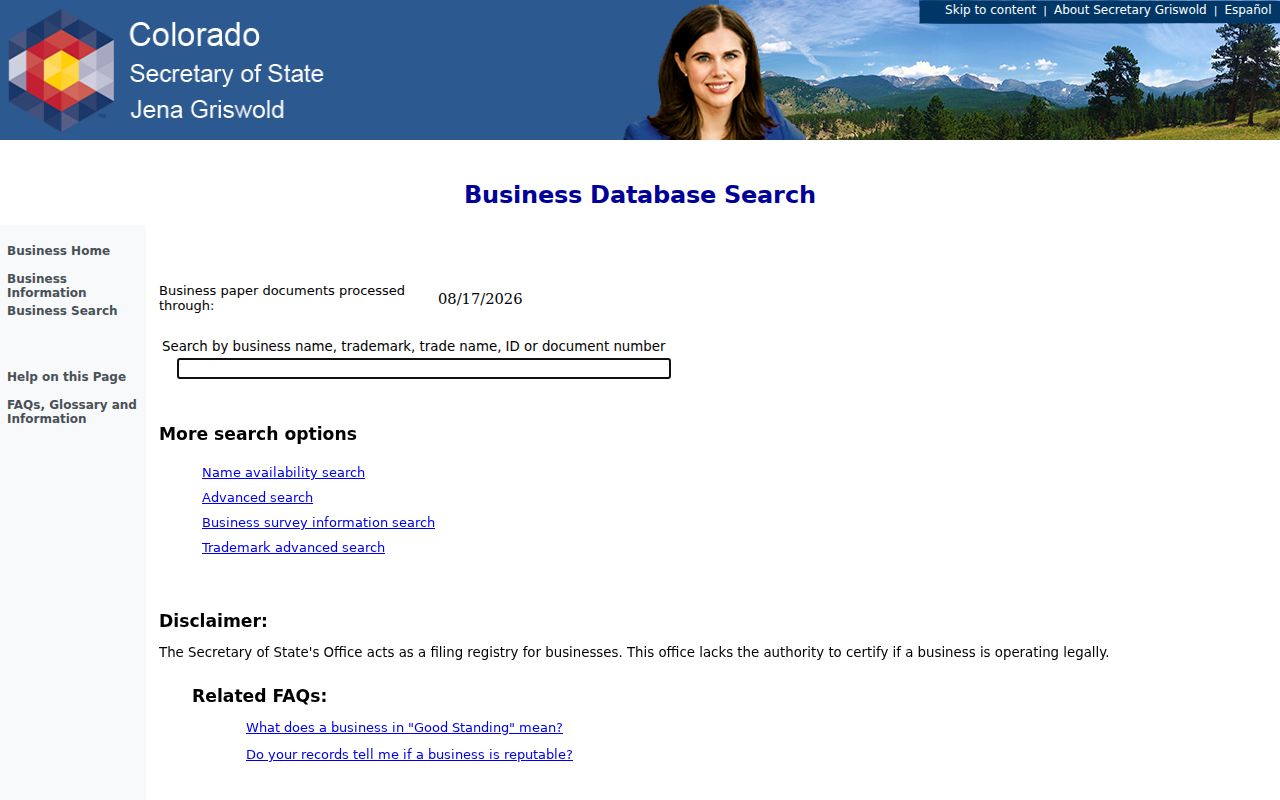
A filing should be checked by entity ID, date, and document, especially when an address appears without a person’s current residence.
Arvada Library Directory Route
Historical research has a practical detour in 2026. The Arvada Library branch closed January 7 for redesign, the temporary Arvada Balsam Library opened January 17, and the project page expects the main branch to reopen in spring 2027. Call the library system before an in-person local-history visit. The collection route remains active through catalog, licensed databases, newspaper microfilm, and reference help.
The named local runs include Arvada Enterprise, 1903-1970 in the county resource listing; Arvada Sun, 1911-1919; Arvada Citizen, 1966-1970; Arvada Citizen-Sentinel, 1970-1979; and Arvada Sentinel, 1979-current. The Colorado Historic Newspapers Collection and Chronicling America add digitized pages, but title gaps and OCR errors remain. A newspaper line can supply a dated name, address, move, notice, or obituary lead. It is printed evidence, not a current official residence record.
The Arvada Historical Society at the McIlvoy House is a second local route for photographs, oral histories, artifacts, and building context. Its archive does not represent a complete household index, and call-ahead access matters.
Arvada Historical Directory Sources
The historical Arvada residents directory is spread across the Denver Public Library’s Colorado Directories Index, Library of Congress telephone volumes, local newspapers, Jefferson County library holdings, and the Historical Society. The index is the best first stop for municipality, county, and year. The scan is the authority for the actual printed line, since OCR may run street names and telephone numbers together.
Colorado telephone volumes include Arvada locality pages from the 1912-1915 period through later volumes, including a September 1950 volume with names, businesses, addresses, localities, and telephone numbers. The 1953 volume notes that Arvada numbers moved to new HArrison 4 numbers. That is a telephone exchange change, not proof of a street renumbering. A regular alphabetical directory answers name to address. A reverse or criss-cross volume may answer address to listed subscriber, but no official Arvada-specific run was verified. Ask the library reference desk to identify the publisher and year before relying on one.
The full collection coverage and entry-reading method belong on the Arvada city directory page. The modern by-address record chain belongs on the street directory page. These are separate research questions even when they meet at one old house.
Arvada Custody and Registry Lookups
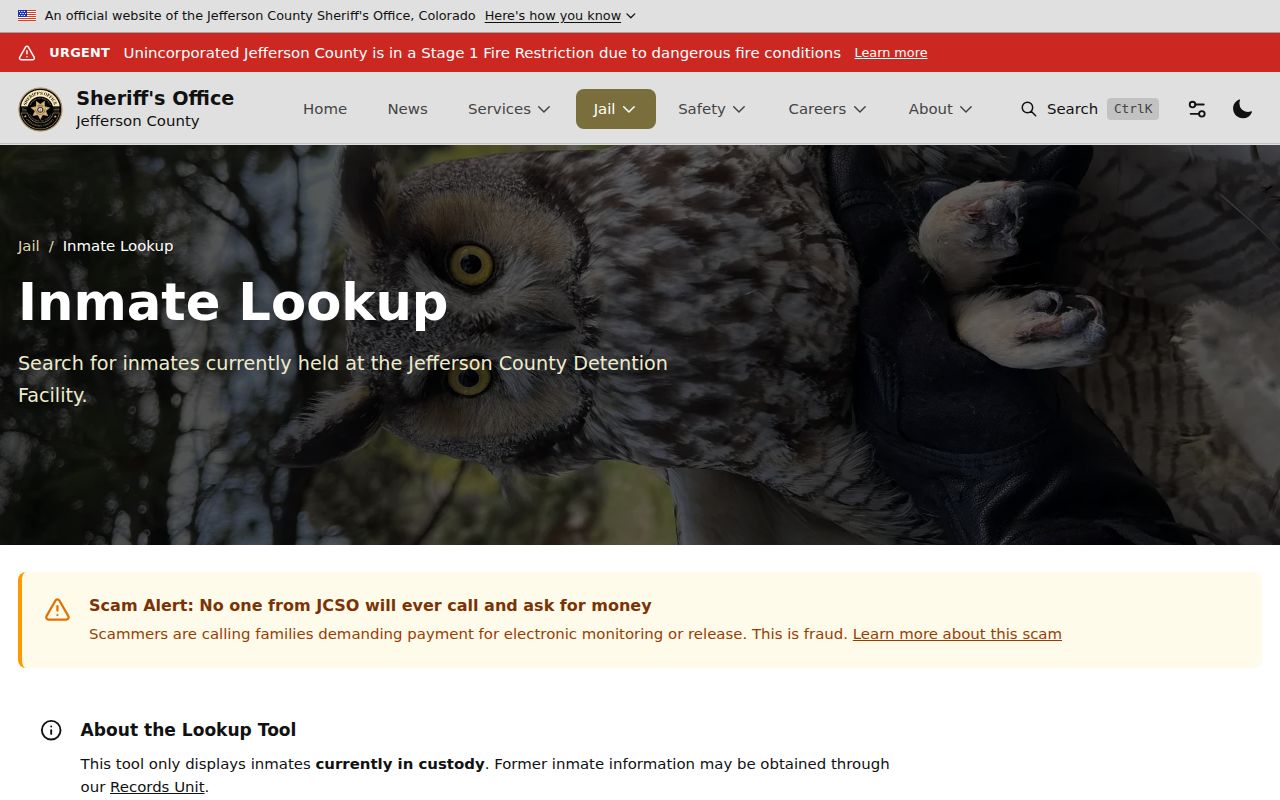
Jail, corrections, and registry tools have narrow purposes. The Jefferson County Sheriff Inmate Lookup searches current custody by last name, first name, and booking date, with an update statement of about fifteen minutes. Former records go to the Sheriff Records Unit. Colorado DOC has a separate current offender search, the Federal Bureau of Prisons covers federal custody from 1982 forward, and the CBI registry has its own agreement, limits, and identity warning.
The public registry is incomplete by design and a name or birth-date match is not positive identity. Juvenile, sealed, protected, and omitted material may not appear. A county jail result does not show a person’s current home. These tools should be used only for the public custody or safety question they answer, with the access date and official warning kept beside the result.
The jail lookup capture shows why the roster carries an update and verification caution.
When a record is needed for a city police report, use the City Clerk’s records route and identify the incident date, location, case number, or report type. Do not turn a custody result into a broad resident claim.
CORA for Arvada Records
The Colorado Open Records Act, C.R.S. §§24-72-200.1 to 206, is the request path when a city or county record is not indexed. A useful request names the custodian, department, record type, address or person, jurisdiction, date range, and preferred format. The state guidance describes a usual three-working-day response, with up to seven additional working days for an extenuating circumstance. Fees can apply for copies, research, retrieval, review, redaction, or production.
Arvada’s JustFOIA route handles general city requests. The city schedule gives the first staff hour free for research, retrieval, review, production, or supervision, then uses a $25 hourly research rate with separate copy and attorney-review charges. For criminal-justice material, the Colorado Criminal Justice Records Act, C.R.S. §§24-72-301 to 309, adds use statements, exemptions, and custodian judgment. CBI’s broader request route requires requester identity, a detailed description, and a signed Pecuniary Gain Form.
A narrow request works better than asking for every record about a name. Ask for a fee estimate before a wide search and ask the custodian to identify redactions or the correct county when an Arvada address is on the Adams side.
Protected Arvada Records and Limits
Colorado vital records are confidential under C.R.S. §25-2-117. Birth, death, marriage, adoption, and divorce records are not an open statewide name index. An eligible applicant must use the CDPHE or local office route, show direct and tangible interest where required, provide identification, and pay the current fee. The Colorado Address Confidentiality Program and county confidential-voter procedures can shield eligible residents with a substitute address or protected record.
The Colorado Privacy Act provides access, correction, deletion, portability, and opt-out rights for covered private controllers, but a valid public deed, court docket, or voter record is governed by its own custodian and statute. A correction request goes to the assessor, recorder, court, Elections office, CBI, or vital-record custodian that owns the source. It is not a reason to repost a disputed address.
Arvada Records: A Local Snapshot
Arvada’s record landscape has a useful local rhythm. The town notice dates to 1870 and incorporation to 1904, while Jefferson County deed books, grantor and grantee indexes, newspapers, and archives reach into the nineteenth century. The Arvada Enterprise bridge runs from the library’s 1903 listing and History Colorado’s 1908-1970 microfilm to digitized issues with gaps. The 2025 recorder expansion improves the modern search layer without replacing the archive.
Current projects add another reason to save a date with every result. The library redesign changes where a local-history request begins. Annexation and water-treatment records around State Highway 93 show how a parcel can move between county and city record contexts. Ralston Creek project files can appear in a map layer, permit chronology, city page, and newspaper while each source uses a different key.
The Arvada residents directory works best as a chain of dated source records: county check, parcel, voter match, deed or docket, then library or archive when the question reaches back. Keep the source type, custodian, coverage, and privacy boundary visible at each step.
The Colorado Treasury’s Great Colorado Payback search is another narrow official lookup for a possible claim, not a general resident list. Its page is shown below because free official tools are safer when reached through the state route.
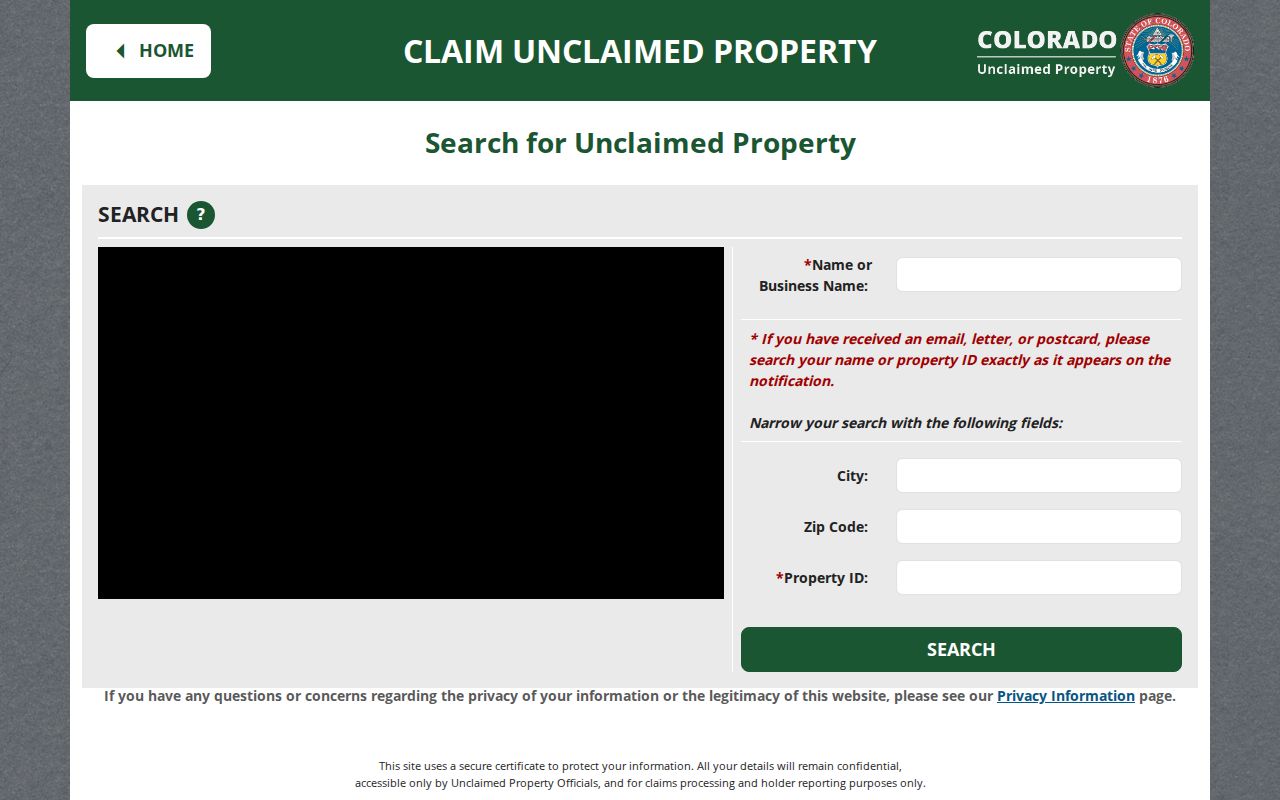
Use the state Treasury route to search and claim, and treat any mailed demand for a release fee as a reason to verify the sender through the official domain.